GSTC Issues New Guidance on Sustainable Tourism Claims as EU Greenwashing Rules Take Effect
TATO Encourages Tourism Businesses to Adopt Clear, Evidence-Based Sustainability Communications and Align Marketing Practices With International Standards
The Global Sustainable Tourism Council (GSTC) has issued new guidance to help GSTC-certified tourism businesses and destinations communicate their sustainability achievements accurately, transparently, and credibly in response to evolving international regulations on environmental marketing claims.
The guidance, titled Guidance on Making Credible GSTC-Certified Claims and EU ECGT Directive Compliance, addresses the growing importance of substantiating sustainability statements and avoiding misleading environmental claims in Sustainable Tourism marketing. It outlines principles for the use of the official GSTC-Certified logo, sustainability-related language, environmental performance statements, and the communication of certification status.
The document highlights the European Union’s Empowering Consumers for the Green Transition (ECGT) Directive, which, according to the GSTC guidance, came into full force across EU Member States on 27 September 2026. The Directive addresses business-to-consumer (B2C) commercial practices, including environmental claims that may mislead consumers about the sustainability of products, services, and destinations.
For Tanzania’s tourism sector, the guidance is particularly relevant as tour operators, accommodation providers, destination managers, and other tourism businesses communicate with international travellers who increasingly encounter sustainability claims when researching and selecting travel experiences.
Tanzania’s tourism industry relies on the strength of its natural landscapes, wildlife, cultural heritage, and community experiences. Communicating the industry’s environmental and social contributions accurately is therefore important not only for maintaining consumer confidence, but also for strengthening the credibility of Tanzania as a responsible tourism destination.
The guidance also provides an opportunity for the Tanzania Association of Tour Operators (TATO) to encourage its members to review their marketing practices, use sustainability terminology responsibly, and ensure that environmental claims are supported by verifiable evidence.
As TATO continues its engagement with the Global Sustainable Tourism Council through its membership, understanding these developments can help the Association promote informed sustainability communication across Tanzania’s tourism industry.
Understanding the EU ECGT Directive and Its Implications for Tourism Marketing
Sustainability has become an increasingly important consideration in the global sustainable tourism industry. Travellers encounter environmental claims across websites, booking platforms, social media, brochures, destination campaigns, and other marketing channels. Statements describing a hotel as environmentally responsible or a destination as sustainable can influence consumer decisions, making the accuracy of these claims particularly important.
The GSTC guidance explains that the EU ECGT Directive is intended to address misleading environmental communications and restrict generic environmental claims unless the applicable conditions are satisfied. It also applies to destinations when their communications constitute business-to-consumer commercial practices.
For tourism businesses serving European markets, these developments highlight the need to examine how sustainability is described and demonstrated in marketing materials.
A company may have introduced measures to reduce plastic waste, improve energy efficiency, support local suppliers, or strengthen community participation. However, a general statement suggesting that the entire business is environmentally sustainable may communicate more than the available evidence supports.
The guidance therefore encourages businesses and destinations to use specific, factual statements that explain what has been achieved, the activities covered, and the evidence supporting the claim.
This approach is particularly relevant to sustainable tourism because sustainability can encompass several different dimensions, including environmental management, local economic benefits, cultural protection, and responsible business operations. A single achievement in one area should not automatically be presented as proof of sustainability across every aspect of a business.
For Tanzania’s tour operators, the practical lesson is straightforward: sustainability marketing should reflect demonstrable actions and clearly defined achievements rather than broad promises that cannot be substantiated.

Why Credible Sustainability Claims Matter to Tanzania’s Tourism Industry
Tanzania attracts travellers through its wildlife, national parks, mountains, cultural heritage, coastal environments, and diverse safari experiences. Many tourism businesses also undertake activities intended to reduce their environmental footprint and strengthen benefits for local communities.
Communicating these efforts can help travellers understand how a business operates and what it contributes to the destinations it serves. However, credibility depends on how accurately the information is presented.
For example, a tour operator that works with local suppliers may be able to describe the proportion of its purchases sourced locally. An accommodation provider that has eliminated single-use plastic water bottles from specified areas may be able to explain the exact scope of that achievement. A business using renewable electricity may be able to identify the facilities or operations covered.
These statements are more informative than broad descriptions such as “green,” “eco-friendly,” or “climate-friendly,” because they communicate a specific practice that can be assessed.
Credible sustainability claims can benefit tourism businesses in several ways:
- Building traveller confidence: Specific statements help potential customers understand the actual sustainability measures a business has implemented.
- Strengthening marketing credibility: Evidence-based communications reduce the risk of creating expectations that a business cannot meet.
- Supporting international market access: Businesses serving international markets need to understand the environmental marketing requirements relevant to their customers and target jurisdictions.
- Encouraging operational improvement: Measuring sustainability achievements helps businesses identify gaps and track progress.
- Protecting Tanzania’s destination reputation: Accurate communication helps ensure that the country’s sustainability story is supported by genuine actions and documented results.
For TATO members, these considerations are especially important when preparing safari itineraries, accommodation descriptions, sustainability pages, promotional campaigns, and social media content aimed at international travellers.
GSTC-Certified Claims: Why Accuracy and Independent Verification Matter
One of the central messages in the GSTC guidance concerns the use of sustainability labels and the official GSTC-Certified logo.
According to the document, the EU ECGT Directive permits sustainability labels only when they are based on a rigorous certification scheme and independently verified by a third party. The guidance states that GSTC certification meets these requirements through monitoring by an independent, competent third party.
For businesses that hold the relevant certification, the official GSTC-Certified logo can therefore serve as an important way of communicating their verified status, subject to the applicable requirements for its use.
However, it is essential to distinguish between GSTC membership and GSTC certification.
Membership of the Global Sustainable Tourism Council does not automatically mean that an organisation, its members, its tourism products, or its destinations have been certified as sustainable. Certification relates to the relevant business, product, operation, or destination within the applicable scope and certification process.
This distinction matters for TATO and its members. TATO’s GSTC membership provides an opportunity to engage with international sustainability knowledge and initiatives, but it should not be presented as proof that all TATO members are GSTC-certified.
Similarly, a tour operator that holds certification for a specific tour package should not imply that every tour, service, or business under the same corporate group has been certified.
The GSTC guidance explicitly emphasises that sustainability claims must accurately define their scope and remain proportionate to the action taken.
Sustainable tourism businesses should therefore confirm their certification status and scope before displaying certification logos or making statements that imply independent verification.
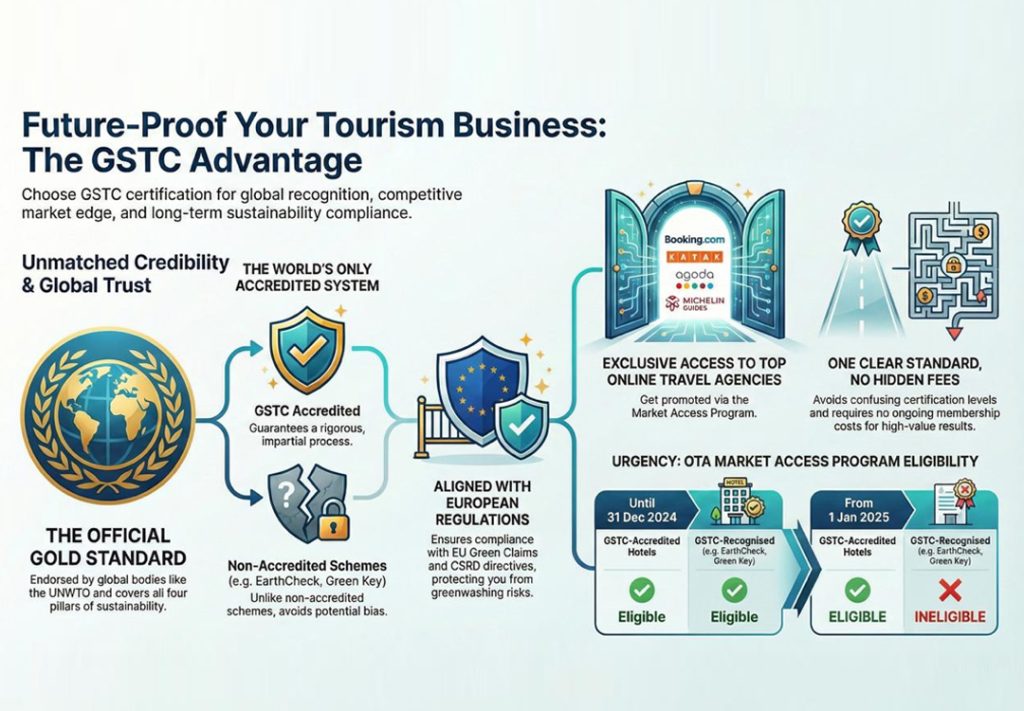
Five Key Principles for Credible Sustainability Marketing
The GSTC guidance provides practical principles for businesses and destinations communicating their sustainability performance. These principles are relevant to sustainable tourism operators reviewing their websites, digital advertising, social media accounts, brochures, and other promotional materials.
1. Avoid Generic Environmental Claims
Terms such as “eco-friendly,” “green,” “climate-friendly,” “conscious,” and “nature’s friend” can create broad impressions about environmental performance without explaining what has actually been achieved.
The GSTC guidance advises businesses to avoid these generic terms unless they can demonstrate recognised excellent environmental performance relevant to the entire claim.
For example, describing an entire safari operation as “100% eco-friendly” may be difficult to substantiate because the business involves transport, accommodation, energy use, food supplies, waste management, and other activities with different environmental impacts.
A more credible approach is to describe the specific measure implemented and provide evidence where available.
Instead of relying on a broad environmental label, a business could explain its waste-reduction programme, the facilities covered by a renewable energy initiative, or the specific measures taken to reduce single-use plastics.
The objective is to communicate meaningful information without suggesting that a business has eliminated every environmental impact.
2. Avoid Unsupported Carbon-Neutrality and Climate Claims
The guidance specifically addresses claims such as “carbon neutral,” “climate neutral,” “CO₂ compensated,” and statements suggesting a reduced or positive climate impact based on carbon offsetting.
It advises businesses not to base such claims on offsetting alone. Instead, claims should reflect the actual lifecycle impact of the product or service, be supported by verifiable evidence, and comply with applicable rules.
This is relevant to safari businesses because transport, vehicle fuel, aviation, accommodation energy use, and other operational activities may contribute to a trip’s overall environmental footprint.
Businesses should therefore avoid making broad climate claims without an appropriate assessment and supporting evidence.
Where a business has measured a particular impact or implemented a defined reduction initiative, it should explain what was measured, which operations were covered, and what the results demonstrate.
3. State Certification Credentials Precisely
The GSTC guidance recommends replacing vague descriptions with clear statements identifying the applicable certification standard.
For example, instead of describing a hotel as an “eco-friendly hotel,” the guidance recommends wording such as “Certified to the GSTC Hotel Standard”, provided that the certification is valid and the statement accurately reflects its scope.
It also provides an example referring to a tour package that has been independently audited and certified against the GSTC Tour Operator Standard.
The same principle applies to sustainable tourism businesses in Tanzania. Certification statements should identify the relevant business, property, destination, or product and must not suggest a wider scope than the certification covers.
Businesses that are not certified should not use wording or visual elements that falsely imply they hold GSTC certification.
4. Support Environmental and Social Claims With Specific Evidence
The guidance encourages businesses to describe actual achievements using clear and measurable information.
Its examples include specifying that all electricity used in guest rooms comes from renewable solar energy or stating that single-use plastic water bottles have been eliminated across all guest rooms and hotel restaurants.
It also addresses socioeconomic performance. Rather than describing a business as “community-friendly,” a company could report the proportion of food ingredients purchased directly from local farmers within a defined distance or explain its compliance with local wage standards and staff sustainability training.
These examples illustrate the value of measurable, verifiable statements.
For Tanzanian tour operators, relevant evidence may relate to local procurement, employment, staff training, waste reduction, energy consumption, or other activities that the business can accurately document.
The figures and claims used in marketing should reflect actual records. Businesses should not adopt illustrative percentages or achievements from the GSTC guidance as though they were their own results.
5. Make Supporting Information Accessible
The GSTC guidance recommends ensuring that information about a sustainability claim, its scope, and how it has been verified is freely and easily accessible to the public.
It also recommends linking claims and the GSTC logo directly to a digital certificate or a dedicated webpage explaining the applicable GSTC Standard.
For sustainable tourism businesses, this means that sustainability information should be easy for prospective travellers to find and understand.
A dedicated sustainability webpage could explain a company’s policies, describe its initiatives, provide relevant measurements, and identify the scope of any certification it holds.
Where a claim relates to a particular property, tour, or service, the supporting information should make that distinction clear.
Transparent communication helps customers assess the information provided and gives businesses a stronger foundation for credible sustainability marketing.
Sustainability Communication Extends Beyond Words and Certification Logos
An important clarification in the GSTC document is that environmental claims are not limited to written statements or official certification labels.
Visual elements can also create an impression about environmental performance. These may include graphics, imagery, symbols, and colour schemes such as green leaves, trees, water drops, or combinations of green and blue when they create a misleading environmental message.
This is particularly relevant to sustainable tourism marketing, where photographs, videos, illustrations, colours, and visual storytelling play a major role in communicating a destination’s identity.
For example, a business may use imagery of pristine forests, clean water, or wildlife alongside branding that strongly implies environmentally superior operations. If the overall presentation creates a misleading impression, changing the wording alone may not address the issue.
Sustainable Tourism businesses should therefore review their complete marketing presentation, including:
- Website sustainability pages and homepage claims.
- Safari brochures and tour descriptions.
- Social media posts, videos, and promotional graphics.
- Digital advertisements and email campaigns.
- Certification logos and sustainability labels.
- Visual branding that may imply environmental performance.
- Links to certification documents and supporting evidence.
The GSTC guidance recommends reviewing existing marketing materials, websites, and social media channels to ensure that claims align with its principles for credible sustainability communications.
For Tanzania’s tourism industry, this is an opportunity to strengthen the quality of sustainability storytelling and ensure that promotional messages reflect the actual practices of the businesses being represented.

The Role of TATO: Supporting Credible Sustainability Communication Across Tanzania’s Tourism Industry
As the representative of Tanzania’s tour operators, the Tanzania Association of Tour Operators (TATO) has an important role in helping its members understand emerging international sustainable tourism standards and communicate their sustainability efforts responsibly.
TATO’s GSTC membership provides an opportunity to strengthen this engagement through international knowledge sharing and greater awareness of sustainable tourism principles. However, translating these principles into practical business improvements requires continued education, dialogue, and cooperation across the tourism sector.
The GSTC guidance offers several areas where TATO can support its members and contribute to the credibility of Tanzania’s tourism industry.
1. Raising Awareness of International Sustainability Requirements
TATO can help its members understand the implications of evolving sustainability communication requirements, particularly for businesses marketing safari packages and other sustainable tourism services to international customers.
This includes sharing relevant guidance on environmental claims, certification terminology, the scope of sustainability statements, and the importance of maintaining supporting evidence.
By helping members understand these issues, TATO can encourage more informed marketing decisions and reduce the risk of unsupported claims that could undermine customer confidence.
2. Encouraging Responsible Tourism Marketing
Tourism marketing is essential for attracting visitors, but promotional claims should accurately represent the services and practices being offered.
TATO can encourage members to review their websites, brochures, social media content, and advertising campaigns to ensure that sustainability statements are specific, proportionate, and supported by evidence.
The Association can also promote the use of clear language that explains actual achievements rather than relying on broad descriptions that may create misleading impressions.
This approach can help strengthen the credibility of individual operators while supporting Tanzania’s wider destination reputation.
3. Promoting Understanding of GSTC Standards and Certification
Through its membership in GSTC, TATO has an opportunity to share information about internationally recognised sustainability frameworks relevant to tour operators.
The Association can help members understand the distinction between sustainability initiatives, formal certification, and organisational membership.
It can also encourage interested operators to explore appropriate sustainability standards, training opportunities, and independent certification processes where relevant to their businesses.
Importantly, TATO should communicate these opportunities without suggesting that its GSTC membership automatically certifies the Association or its members.
4. Supporting Capacity Building and Knowledge Sharing
Tour operators have different levels of experience, resources, and capacity to measure and communicate sustainability performance.
TATO can help address these differences by facilitating knowledge-sharing activities, workshops, technical discussions, and practical guidance on responsible tourism operations and communications.
Topics could include documenting environmental improvements, measuring local procurement, managing waste, protecting cultural heritage, reducing resource consumption, and communicating verified achievements.
Such initiatives can help businesses move from general sustainability commitments towards practices that are more clearly defined, measurable, and continuously improved.
5. Strengthening the Credibility of Tanzania’s Tourism Brand
Tanzania’s international tourism reputation depends on the quality of its visitor experiences and the long-term protection of its natural and cultural assets.
TATO plays an important role in promoting the country through its engagement with sustainable tourism operators, international markets, and relevant stakeholders.
By encouraging accurate sustainability communication, the Association can help ensure that promotional messages reflect genuine practices and verifiable achievements.
This is particularly important in a competitive international tourism market, where credible information can help travellers make informed choices and distinguish between broad marketing language and demonstrable action.
6. Facilitating Dialogue Between the Private Sector and Other Stakeholders
Sustainable tourism involves businesses, government institutions, conservation authorities, destination managers, communities, and international organisations.
TATO can contribute to this collective effort by bringing the experiences of tour operators into relevant discussions and facilitating the exchange of information among stakeholders.
This engagement can help identify practical challenges, encourage cooperation, and support a tourism environment in which responsible business practices and credible communication are increasingly prioritised.
Through continued dialogue, TATO can help connect international sustainability developments with the operational realities of tourism businesses in Tanzania.
Practical Steps for TATO Members Following the GSTC Guidance
Tour operators and other tourism businesses can begin by reviewing their existing sustainability communications and checking whether their claims accurately reflect their operations.
The following checklist provides a practical starting point.
- Review sustainability language: Identify broad claims such as “eco-friendly,” “green,” or “climate-friendly” and assess whether they are sufficiently specific and supported.
- Verify certification status: Confirm that any certification claim or logo is valid and applies to the business, property, product, or service being promoted.
- Document sustainability achievements: Maintain evidence supporting claims about waste reduction, renewable energy, local procurement, employment, training, or other initiatives.
- Check climate-related statements: Review carbon-neutrality and offset-related claims against the applicable requirements and available evidence.
- Audit visual marketing: Assess whether photographs, graphics, symbols, colours, or branding could create a misleading impression about environmental performance.
- Clarify the scope of claims: Ensure that an achievement relating to one property, tour, or business activity is not presented as applying to the entire organisation.
- Improve public transparency: Make relevant supporting information easy to access, including links to valid certification documents where appropriate.
- Review all marketing channels: Apply the same standards to websites, social media, brochures, advertisements, and other customer-facing communications.
These steps reflect the principles outlined in the GSTC guidance and can help businesses strengthen the accuracy and transparency of their sustainability marketing.
Businesses should also seek clarification from GSTC where necessary, particularly regarding the appropriate use of its logo or the communication of certification status. The guidance identifies info@gstc.org as the contact address for such questions.

Building a More Credible and Responsible Future for Tanzania’s Tourism Industry
The GSTC guidance on credible sustainability claims and EU ECGT Directive compliance highlights an important development in international tourism: businesses must be able to substantiate the environmental and social messages they communicate to consumers.
For Tanzania’s tourism industry, this presents both a responsibility and an opportunity.
Tour operators, accommodation providers, and other tourism businesses can strengthen their market credibility by explaining their sustainability initiatives accurately, documenting measurable achievements, and ensuring that certification claims reflect their actual status.
The guidance also reinforces the importance of distinguishing between genuine operational improvements and broad marketing statements that may create unrealistic expectations.
As an official GSTC member, TATO has an opportunity to strengthen awareness of these principles, support its members through knowledge sharing, and encourage responsible sustainability communication across the industry.
TATO’s role is to help connect international sustainability developments with Tanzania’s tourism business community, while promoting practices that support the credibility, competitiveness, and long-term resilience of the sector.
By working with its members and relevant stakeholders, the Association can contribute to a tourism industry in which sustainability claims are backed by evidence, environmental and cultural responsibilities are taken seriously, and visitors receive clear and reliable information about the experiences they choose.
Ultimately, credible sustainability communication is not simply a marketing exercise. It is part of building trust between tourism businesses, travellers, local communities, and the destinations that make Tanzania distinctive.
Through informed engagement, responsible marketing, and continued industry collaboration, Tanzania’s tourism sector can strengthen its international reputation while supporting the long-term protection of its natural and cultural heritage.


